Selecting the ideal projector technology is essential for achieving the best visual performance in home entertainment, business presentations, educational environments, and professional installations. Among the most widely used projection technologies today, DLP (Digital Light Processing) and LCD (Liquid Crystal Display) projectors remain the two dominant choices in the global projector market.
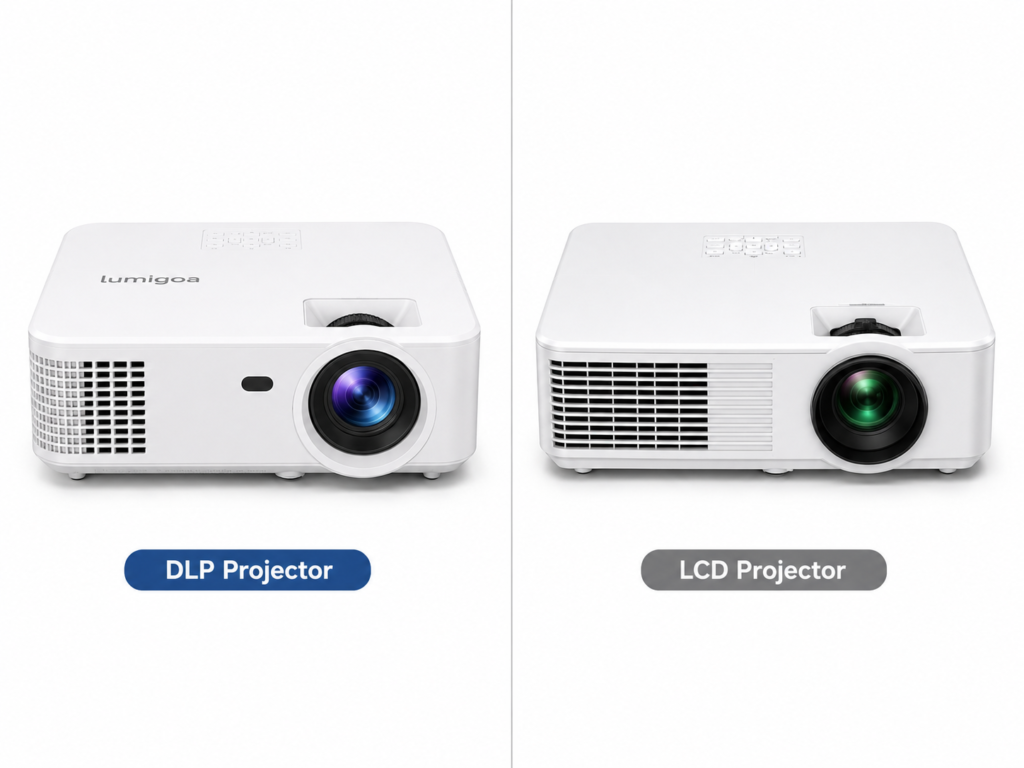
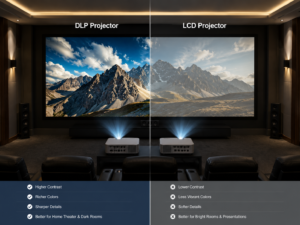
Both projector technologies offer distinct advantages in areas such as image quality, brightness, color accuracy, contrast performance, and long-term reliability. DLP projectors are widely recognized for their sharp image rendering, high contrast ratios, and smooth motion performance, making them popular for home theaters and professional applications. In contrast, LCD projectors are valued for their vibrant color reproduction, strong brightness efficiency, and detailed image presentation, especially in business and educational environments.
Understanding the core differences between DLP vs LCD projectors is crucial when selecting the right projection solution for your specific needs. In this comprehensive comparison guide, we will explore the working principles, advantages, limitations, performance characteristics, and ideal applications of both technologies to help you make a more informed purchasing decision.
Brief Overview of Projectors
DLP projectors are known for their sharp image quality, high contrast ratios, and smooth motion performance, making them ideal for home theaters, gaming, and professional applications. In contrast, LCD projectors offer vibrant colors, strong brightness, and cost-effective performance, making them popular for classrooms, offices, and business presentations. Both technologies have unique advantages, and the right choice depends on your viewing needs, environment, and budget.
Importance of Choosing the Right Projector Technology
Selecting the right projector technology is essential for achieving the best viewing experience and long-term performance. Different projection systems offer unique advantages in image quality, brightness, color accuracy, portability, and maintenance requirements. Choosing the most suitable projector depends on your application environment, usage frequency, and budget.
Among modern projection technologies, DLP projectors and LCD projectors are the two most common options in both consumer and commercial markets.
DLP (Digital Light Processing) projectors use advanced Digital Micromirror Device (DMD) technology to deliver sharp images, high contrast ratios, and smooth motion performance. They are widely appreciated for their compact design, reliability, and low maintenance requirements, making them ideal for home theaters, gaming, and professional presentations.
In comparison, LCD (Liquid Crystal Display) projectors utilize liquid crystal panels to produce bright and color-rich visuals. LCD technology is known for excellent color brightness, detailed image reproduction, and cost-effective performance, especially in classrooms, meeting rooms, and multimedia presentation environments.
DLP vs LCD Projectors: Key Differences
| Features | DLP Projectors | LCD Projectors |
|---|---|---|
| Image Quality | Sharp images with strong contrast | Bright and detailed visuals |
| Color Performance | Excellent contrast and smooth motion | More vibrant color brightness |
| Portability | Compact and lightweight | Generally larger in size |
| Maintenance | Lower maintenance requirements | Requires more frequent cleaning |
| Noise Level | Typically quieter operation | Cooling fans may generate more noise |
Understanding these differences can help users select the most appropriate projector solution based on their performance expectations and installation needs.
DLP (Digital Light Processing) Projectors
Brief History and Development
DLP (Digital Light Processing) technology was first developed by Texas Instruments in the late 1980s and has since become one of the most widely used projection technologies in the global display industry. Over the years, continuous advancements in optical engineering and digital imaging have enabled DLP projectors to deliver higher brightness, improved color accuracy, enhanced contrast ratios, and better overall image performance.
Today, DLP technology is widely applied in home theaters, business presentations, educational environments, digital cinema systems, simulation platforms, and large-scale commercial projection installations.
How DLP Projectors Work
At the core of every DLP projector is a Digital Micromirror Device (DMD) chip. This advanced semiconductor component contains thousands or even millions of microscopic mirrors, with each mirror representing a single pixel in the projected image.
These mirrors rapidly tilt to reflect light either toward or away from the projection lens, allowing the projector to create highly detailed visuals with excellent precision. Most single-chip DLP projection systems also use a rotating color wheel to generate red, green, and blue primary colors, which are combined to produce full-color images.
By precisely controlling light reflection at high speeds, DLP technology delivers:
- Sharp image clarity
- High contrast performance
- Smooth motion reproduction
- Consistent brightness levels
This digital imaging architecture makes DLP projectors highly suitable for both entertainment and professional applications.
Advantages of DLP Projectors
High Brightness Performance
One major advantage of DLP projectors is their strong brightness capability. Many models deliver high lumen output, making them ideal for conference rooms, classrooms, auditoriums, and other environments with ambient lighting.
Excellent Contrast Ratio
DLP technology provides superior light control, allowing projectors to produce deeper black levels and more detailed image contrast. This creates a more immersive and realistic viewing experience, especially for movies and high-definition content.
Compact and Portable Design
Compared to many traditional projection systems, DLP projectors are often more lightweight and compact. Their portable design makes them suitable for mobile presentations, business travel, and flexible installation scenarios.
Reliable Performance and Lower Maintenance
Because DLP systems typically contain fewer internal components susceptible to image degradation, they are known for long-term reliability and reduced maintenance requirements. Many modern DLP projectors also utilize LED or laser light sources, further extending operational lifespan and minimizing maintenance costs.
Disadvantages of DLP Projectors
Despite their many advantages, DLP projectors also have several limitations that users should consider before making a purchasing decision.
Rainbow Effect
One of the most commonly discussed issues with single-chip DLP projection technology is the “rainbow effect.” This phenomenon appears as brief flashes of red, green, and blue colors during high-contrast scenes or rapid eye movement. It occurs because many single-chip DLP projectors rely on a rotating color wheel to generate colors.
Although modern DLP systems have significantly reduced this issue through faster color wheel technology and improved processing, some sensitive viewers may still notice the effect.
Color Accuracy Limitations
While DLP projectors are widely praised for their excellent contrast ratios and smooth motion performance, certain models may offer less accurate color reproduction compared to high-end LCD projection systems. This difference is more noticeable in applications requiring precise color performance, such as professional photo editing or color-critical visual work.
Higher Initial Cost
Compared with entry-level LCD models, some DLP projectors can be more expensive due to their advanced imaging technology and optical components. However, many users consider the improved durability, lower maintenance requirements, and superior contrast performance to provide strong long-term value.
Overall, DLP projection systems remain a popular choice for home theaters, gaming, commercial displays, and professional presentation environments due to their sharp image quality, reliability, and compact design.
LCD (Liquid Crystal Display) Projectors
Brief History and Development
LCD (Liquid Crystal Display) projectors were first introduced during the 1980s as projection technology evolved from early liquid crystal display applications used in calculators, watches, and small electronic devices. With continuous improvements in LCD panel manufacturing and optical systems, modern LCD projectors now deliver brighter images, enhanced color accuracy, and improved overall viewing performance.
Today, LCD projectors are widely used in classrooms, conference rooms, business presentations, and home entertainment applications because of their strong brightness output and vibrant color performance.
How LCD Projectors Work
LCD projectors operate by passing light through three separate liquid crystal panels — one each for red, green, and blue primary colors. The light source, which may use traditional lamps, LED illumination, or laser technology, shines through these panels to create the projected image.
The colored light is then combined through a prism system and projected through the lens onto the screen. This three-panel architecture enables LCD projectors to deliver bright and highly saturated color reproduction.
Advantages of LCD Projectors
Excellent Color Accuracy
One major strength of LCD projection technology is its ability to produce vibrant and accurate colors. Because LCD projectors use dedicated panels for each primary color, they often provide strong color brightness and natural-looking image reproduction.
This makes them highly suitable for:
- Business presentations
- Educational environments
- Multimedia content
- Photo and video display applications
High Brightness Performance
Many LCD projectors offer high lumen output, making them effective in brightly lit environments such as classrooms, meeting rooms, and offices.
Sharp Image Detail
LCD technology is known for producing crisp and detailed visuals with strong text clarity, which is particularly beneficial for presentations, spreadsheets, and educational content.
Disadvantages of LCD Projectors
Larger Physical Size
Due to their multi-panel optical structure and cooling systems, LCD projectors are often larger and heavier than comparable DLP models, reducing portability.
Higher Maintenance Requirements
Many LCD projectors use air filters to prevent dust accumulation inside the optical system. These filters require periodic cleaning or replacement to maintain performance and prevent overheating.
Lower Contrast Ratios
Compared with DLP projectors, LCD systems generally deliver lower contrast performance and less detailed black levels. As a result, dark scenes in movies or cinematic content may appear less immersive.
Understanding both the strengths and limitations of LCD technology can help users determine whether an LCD or DLP projector better matches their application requirements and viewing preferences.
Comparison: DLP vs LCD Projectors
Image Quality
When comparing DLP vs LCD projectors, image quality is one of the most important factors.
DLP projectors are known for:
- Smooth image rendering
- Strong motion performance
- Reduced visible pixelation
- High contrast visuals
In contrast, LCD projectors typically provide:
- Sharper text clarity
- Strong image detail
- Vibrant color presentation
The differences primarily result from the distinct imaging technologies used by each system.
Contrast Ratio
Contrast ratio plays a major role in overall visual performance.
DLP projection technology generally delivers higher contrast ratios because the Digital Micromirror Device (DMD) can control light more precisely, producing deeper black levels and improved image depth.
LCD projectors may experience slight light leakage between panels, which can reduce black-level performance in dark scenes.
Color Accuracy
Color reproduction is another key comparison factor.
Modern LCD projectors are often recognized for stronger color brightness and highly saturated visuals, while advanced DLP projectors can produce extremely wide color ranges and smooth color transitions.
High-end 3-chip DLP projectors are capable of delivering exceptionally accurate color performance for professional applications.
Resolution and Sharpness
Both DLP and LCD projectors support high-resolution formats, including Full HD and 4K projection.
LCD projectors often appear sharper for detailed text and static content, while DLP projectors typically provide smoother image rendering with less visible pixel structure.
Performance and Portability
In terms of portability and long-term reliability:
- DLP projectors are generally more compact and lightweight
- LCD projectors are often larger due to their optical panel design
- DLP systems usually require less maintenance
- Laser and LED DLP models offer extended operational lifespan
These factors make DLP projectors popular for mobile presentations and flexible installations.
Price and Overall Value
Both technologies are available across multiple pricing categories.
- Entry-level LCD projectors are often more affordable for classrooms and office use
- DLP projectors frequently provide better long-term durability and contrast performance
- Premium laser and 4K projection systems are available in both technologies
Choosing the right projector depends on balancing image quality, brightness, maintenance, portability, and overall budget requirements.
Use Cases: Which Projector Technology Is Best for Different Scenarios?
Choosing between DLP projectors and LCD projectors largely depends on the intended application, installation environment, and performance expectations. Each projection technology offers unique advantages for specific usage scenarios.
Home Theater
For home theater environments, both DLP and LCD projectors can deliver excellent cinematic experiences, but they excel in different areas.
DLP projectors are widely preferred for home cinema systems because of their high contrast ratios, deeper black levels, and smooth motion handling. These features create a more immersive viewing experience for movies, sports, and fast-moving video content.
Meanwhile, LCD projectors are known for vibrant color reproduction and sharp image detail, making them suitable for users who prioritize bright and vivid visuals.
For dark-room movie viewing and cinematic performance, many users prefer high-contrast DLP home theater projectors.
Gaming
Gaming performance depends heavily on response time, image smoothness, and input lag.
DLP projectors typically offer faster response times and smoother motion rendering, making them ideal for fast-paced gaming experiences such as racing games, first-person shooters, and sports titles.
On the other hand, LCD projectors can provide highly detailed visuals and strong color brightness, which may benefit visually rich or story-driven games.
When selecting a gaming projector, users should also consider:
- Input lag
- Refresh rate
- Resolution
- HDR compatibility
- Brightness performance
Business Presentations
For business and conference applications, DLP projectors are often favored because of their portability, durability, and lower maintenance requirements.
Their compact design and long-lasting optical performance make them highly suitable for:
- Meeting rooms
- Mobile presentations
- Conference centers
- Corporate training environments
Many modern business DLP projectors also provide high brightness output, ensuring clear visibility even in well-lit rooms.
Education and Classroom Use
Both LCD and DLP projectors are widely used in educational environments.
LCD projectors are commonly chosen for classrooms because they deliver bright images, sharp text clarity, and strong color brightness, making educational content easier to read and understand.
However, DLP projectors may offer advantages in terms of durability, portability, and lower long-term maintenance costs, especially for schools operating under tighter budgets.
The ideal solution often depends on classroom size, ambient lighting, and usage frequency.
Large Venues and Professional Events
For large-scale projection applications such as auditoriums, exhibitions, stage events, and digital signage installations, DLP projection technology is generally considered the preferred choice.
Professional laser DLP projectors and 3-chip DLP systems provide:
- Extremely high brightness levels
- Excellent image consistency
- Strong contrast performance
- Reliable large-screen projection capability
DLP technology also performs well in advanced setups involving:
- Multi-projector edge blending
- Projection mapping
- Simulation systems
- Immersive visual installations
LCD projectors can still perform effectively in smaller venues with controlled lighting conditions, particularly where strong color brightness is required.
Conclusion
Key Takeaways
When comparing DLP vs LCD projectors, both technologies offer distinct advantages depending on the application scenario and viewing requirements.
Key differences include:
- DLP projectors use Digital Micromirror Device (DMD) technology to create sharp images with strong contrast and smooth motion performance.
- LCD projectors use liquid crystal display panels to produce bright, colorful, and highly detailed visuals.
- DLP systems are typically more compact, portable, and lower maintenance.
- LCD projectors often provide stronger color brightness and excellent image sharpness for presentations and educational use.
Understanding these differences is essential when selecting the right projection solution for your environment.
Recommendations Based on Different Needs
The best projector technology depends on your priorities and intended usage.
- Choose a DLP projector if you value high contrast, portability, smooth motion, and long-term reliability.
- Choose an LCD projector if you prioritize color brightness, detailed visuals, and cost-effective presentation performance.
- For professional cinema, simulation, and large venue applications, high-end laser DLP projectors and 3-chip DLP systems often provide the best overall performance.
Additional Factors to Consider
Beyond projection technology itself, buyers should also evaluate several other important factors before purchasing a projector:
- Brightness and lumen output
- Resolution and image quality
- Throw distance and installation flexibility
- Lamp life or laser lifespan
- Connectivity options
- Maintenance requirements
- Total cost of ownership
As an experienced projector manufacturer, we recommend carefully balancing image performance, reliability, budget, and application requirements to ensure the best long-term viewing experience.
Whether for home entertainment, gaming, education, business presentations, or professional installations, both DLP and LCD projectors continue to play important roles in today’s rapidly evolving projection industry.